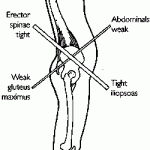
Core stability and pain: Is it time to stop using the word stability to explain pain?

Tags: No Tags
Comments: 58 Comments
Published on: December 26, 2012

Purpose: To cherry pick a few research articles to suggest that even though our knowledge of core stability is very impressive its link to pain is poor.

Nutshell summary: People in pain have spines that function differently than those not in pain.  Many treatments can influence pain.  The spine stability model of low back pain does not explain how people have pain and takes an overly mechanical view of the pain experience.  No test has ever shown that a spine is unstable or how “increasing stability” would lead to a decrease in pain.  Thinking that our spines need more stability or control may be the completely wrong path in explaining how people have pain or how our exercises help them.   Our treatment “corrections” occur not via one specific “corrective” mechanism (e.g. improving stability) but rather through global non-specific mechanisms that our better explained by our understanding of pain neuroscience.  Making the shift from believing that “stability” is the issue with pain can thus free up to choose completely different exercise programs.  Exercise and treatment prescription thus become simpler.  We have preliminary evidence to support this view with the clinical studies that show benefits with the various exercise conditioning programs that train different schools of thought on stability or the just as effective programs that completely ignore any concepts of stability.

(more…)

Strength first, core last: Modifying core training for runners

Tags: No Tags
Comments: No Comments
Published on: May 18, 2013

front bridge from knees


Don’t get me wrong.  I love respect the core. But you can’t open a running book, magazine or blog without hearing how important it is for runner’s to train the core.  I agree with this to some extent but for 10 years I have advocated for three points to keep in mind when it comes to runners and core training: (more…)

Ditching the Plank? Strength training is core training.

Tags: No Tags
Comments: 1 Comment
Published on: May 18, 2013

Background

The piece was part of a companion piece on resistance and “core” training for runners.  The thrust of that piece was that general resistance training should come first before gut-blasting 5 session/week plank marathon sessions should occur.

Purpose: core exercises are rampant and extremely hyped. They are much too popular and I think many athletes not working with strength coaches focus on the core and perhaps neglect other body parts.  A not at all new thesis is that many simple core exercises can be replaced by compound exercises that have other goals (e.g. train the legs) but still require great core activation.

deadlift down


(more…)

Trail running clinics with duathlete Jennifer Faraone

Categories: Uncategorized
Tags: No Tags
Comments: No Comments
Published on: May 6, 2013

Elite Duathlete Jennifer Faraone is hosting two trail running clinics at Rattlesnake Point, Milton Ontario.

June 2 Trail Running for Beginners

July 7 Getting Stronger and Faster on the Trails.
Both sessions will be held at Rattlesnake Point Conservation Area (Milton) and space is limited.

Static stretching: not evil, not a panacea just a

Tags: No Tags
Comments: 6 Comments
Published on: April 4, 2013

This brief post has two main points:

Static stretching is not going to kill your performance

and

Static stretching is not a cure-all

Further, nothing in this post is even remotely new.

(more…)

Neurodynamic Nerve Slider Pictures – helping people with pain

Tags: No Tags
Comments: 3 Comments
Published on: March 1, 2013

Below I have created neurodynamic nerve slider pictures.  I use them in handouts for patients and now you can too!  They are strongly inspired (ahem, completely based on) David Butler’s work.

(more…)

Stu McGill Course in Toronto February 23-24

Categories: Uncategorized
Tags: No Tags
Comments: No Comments
Published on: February 18, 2013

Dr McGill is teaching a two day course on his research behind spine stability.  I have been an admirer of Stu for more than 17 years and was lucky enough to do more MSc under his supervision.


I consistently learn a great deal from Dr McGill and encourage anyone with even a passing interest in spine stabilty and athletic performance to see him speak or read his work


Course information at The msk-plus website.


Dear Julie: In defense of the crunch

Tags: No Tags
Comments: 18 Comments
Published on: February 14, 2013

Dear Julie,

You wrote an interesting letter on your beautiful website (www.juliewiebept.com) to the coach of your girl’s gymnastic program.  You wished to


share with you and your staff how a decade or so of research is transforming our understanding of how we create a strong sturdy center that anchors all of our movements

As a father of two young girls (5 and 3) I really appreciated your views on healthy sports participation, concerns about body issues and the importance of fun in physical activity.  Like you I am also a physiotherapist with a special interest in spine function. I am also a chiropractor, was a spine biomechanics researcher, I completed a MSc in Spine Biomechanics with one of the authors of the references you cited (Stu McGill), I have published a few papers on trunk muscle function (here, here and here) during a variety tasks and was initially very interested in doing research on the lowly and often derided abdominal crunch (here and here).   I love talking about spine stability and how much of this actually old research (I don’t think it’s emerging, most has been around since the 90s) is applied to clinic or sport in ways that the research does not actually support.  I am also a former recreational gymastics coach and regularly “threw back tucks” after two beers at parties well into my twenties. (more…)

Quick EMG Review: Training the rotator cuff trains the scapulothoracic muscles

Tags: No Tags
Comments: 8 Comments
Published on: February 8, 2013

I had a discussion with a Physio friend of mine about a blog he wrote championing performing scapular stability exercises before rotator cuff exercises.  Because I am bit of a picky bitch I immediately thought that while I can see the clinical rationale for it I don’t think the muscles actually do this in practice and thus we had a respectable difference of opinion.  From some old EMG reviews I knew that some of the best exercises to train the lower traps (with out upper trap activity) were actually lame old rotator cuff exercises.  A couple of  years ago I made a few graphics that illustrated this (prompted by a similar discussion on Mike Reinold’s blog).

(more…)

Golf swing kinematics ebook. Implications for performance, training and injury

Tags: No Tags
Comments: 9 Comments
Published on: January 26, 2013

A lot of my previous research (much unpublished) was on golf biomechanics and its the only sport that I am better than average at yet I never write about it.  So to rectify that I have attached an ebook.  Its nothing special, this information is out there, but it does bring a lot together for those interested.

I did a talk last year on this topic and have some of the rough notes I used.  Below is 40 page ebook on the lecture.

The majority of the graphs are my copyright from 3D kinematic data we collected on a study 6 years ago looking at the influence of static stretching on pelvis and thorax kinematics during the swing.  Please feel free to use my pictures however you see fit.

The ebook is a simple overview of how the spine moves during the swing.  It also reviews the academic literature on what kinematic variables of the swing are related to performance and what individual golfer variables are related to performance.  Last, I touch on injury but this is a murky area and I mostly avoid it.  We don’t have a lot of good research on injury mechanism (like most areas) so feel free to make up whatever you like like everyone else does. :)

Here it is:  golf biomechanics ebook compressed

A related link is at the mytpi.com (Titleist Performance Institute) website.  This is one of the best golf biomechanics/fitness websites around.  They have a huge amount of free information and its mostly very good – especially their biomechanics.

Changing your running form. What can you do to influence pain?

Tags: No Tags
Comments: 2 Comments
Published on: January 22, 2013

Purpose: To list a number of gait adaptations that you can make that might help you run injury and pain free.

Background

I’m of the opinion that running is rehab. Here are some running rehabilitation thoughts that justify changing your gait during a return to running and some things you might want to keep in mind. Please remember, this is not comprehensive and should not be viewed as the only things you do to rehab injuries or run pain free.  This is one aspect.  Please see a professional for help.

1. Pain does not equal injury – keeping running while you are injured helps keep your fitness but can also decrease the threat and fear associated with the injury.  In the picture below there are three lines.  The first is your injury threshold.  This can be breached when you do too much too soon and don’t give your body the time to adapt to the stresses you place on it.  The second line is your pre-injury or pre-pain experience pain threshold.  This the point in terms of physical stress where you used to start feeling pain.  This line is your warning line created by the brain.  The third line is your new pain threshold. When you have pain/injury you often start to feel pain much sooner.  It is like a habit and you get better at feeling pain.  We want to break this habit. Running as rehabilitation lets you just “gently poke the bear”.  Your goal is to change the threshold of where you start to feel pain.  You are NOT hammering through pain.  You are just going to the edge and then backing off.  By exposing your body and brain to running again we slowly creep up that pain threshold line.  This occurs through physical adaptations but also neurological plasticity (i.e. changing that pain habit through graded motor exposure).

injury and pain thresold


2. Don’t run through pain – run just to the edge of pain.  If you feel pain start to walk for 30-60 seconds.  Run again for a little bit.  Keep increasing your exposure slowly.

3. Add variety – remember pain is more than injury.  Pain is very context related.  Ever heard about Vietnam veterans being hooked on heroine in Vietnam, coming home and having no cravings but when the go back for a visit they are jonesing for a fix.  This is context.  Pain is a habit and can be triggered by context.  Change your running context.  Different shoes, different paths, times of day, don’t run perfectly straight, veer, weave and changeis. your form (more on this).  A lack of variety continually stresses the same tissues but can also activate the same neurosignature associated with the pain you feel.  Lets avoid this.

Gait Modifications you can make

We have biomechanical justifications for many of the recommendations below.  The research is mixed but we can say that you will experience different tissue stresses when you make these adaptations.  Many professionals will suggest that the adaptions address a specific deficit or flaw in your form - this may be true but there are also more general and less reductionistic explanations.  We we can also argue that merely changing something about your running is enough to create a stimulus for your tissues to adapt, to change the stress on some neurally irritated areas and to break the pain habit with variety and graded exposure.  But I digress, here are things that you can do.

1. Don’t overstride

Be conscious of where your foot lands in relation to your body.  Film yourself on a treadmill.  Is your foot way out in front of you? Is your lower leg far from being perpendicular to the ground? Is your knee straight at impact?  Work on feeling like your foot is landing behind you (I recognize that this is impossible as is having it land underneath you but still attempt this and in the attempt you will get your footstrike closer to  your center of mass).

2. Increase your cadence

This is strongly related to not overstriding and is another way to work on having your footstrike closer to your body.  I don’t believe in any magic number as I feel that cadence is strongly linked to speed.  If you are running slower than a 6 minute/km pace than it will be tough for you to get higher than the supposed magical 180 steps/min.  So don’t worry about it.  Just try to take lighter, quicker steps. A general rule is an increase of 5-10%.  Increasing this excessively will most likely influence your running economy in the bad way.

3. Pull with your glutes

Again, many of these are inter-related.  The idea behind this is twofold:

a. this may decrease overstriding by increasing your hip extension (i.e. how much your thigh goes behind you).  See  detailed review here.

b. this may decrease how much your pelvis drops side to side and the amount of knee valgus that occurs during ground contact. These variables are often linked with knee pain in runners.

What you do is you tighten your butt when your foot hits the ground and feel that  your are pulling your leg backwards while it is on the ground.  Feel like you are even pulling the ground.  Do this for 30-60 seconds out of every 600 to 1000 meters.

4. Modify the impact of your running by running softer.

My favorite running researcher is Irene Davis. Much of what I know I owe to her body of research over the past 15 years.  Dr Davis has recommended for years that one of the simplest ways to change the loading rate (or tibial shock) in runners is to simply instruct them “To run softer“.  Isn’t that awesome?  Just let the runner figure out a way.  Some runners might shift to a forefoot strike, some might heelstrike but they will find a way to make less noise and run softer.  See a minor review of ways to change impact loading here.

5. Change your footstrike

I don’t believe in any ideal foot strike.  I have advised runners in the past to try running with a heelstrike yet a forefoot and midfoot striking gets all the positive press and the heelstrike is deemed a faulty wanker.  I think they can all be beneficial and appropriate at different times.  If you are having trouble with  your calves or your metatarsals then maybe trying to run with a light heelstrike for 30 to 60 seconds out of every three minutes is right for you.  The inverse is also true.  Been having knee and hip pain?  Try shifting to a forefoot or midfoot strike for 30 seconds out of every three minutes.  Increase over the course of a few weeks the amount of time you spend forefoot striking.  See a review of form, footwear and footstrike here and a review of barefoot and footstrike styles here.

6. Change your speed

Michael Fredericson recommended this more than a decade ago after noticing that many ITB painful patients felt better when running with increased speed. The key again, is variety and sharing the load across different tissues and changing context.  Do 15-30 second pickups every kilometer.

7. Run with your feet slightly wider apart

Running with your feet just 2 inches wider has been shown to change the tension on the ITB (abstract here)and on the amount of pronation at the foot (abstract here).  Again, the mechanism for this being helpful is that it is different and thus has novel stresses on the tissues.

Remember, variety is good for injury.  If you run a factory that builds cars the best way to injure your workers is to have them do the exact same thing thousands of times a day.  The safer method is to have them perform a lot of different tasks through out the day.  Training can be seen much the same.

As an aside, this is also why I am not a fan of the ideal sitting posture.  Throw that 1950s stenographer posture out the window.  Slouch, lean one way, then the other, cross your legs, feet on the desk, head tilted back, trunk rounded, trunk straight, arm rests, no arm rests –Variety, novelty, tissue load distribution.  We aren’t built to do the same thing. Forget the ideal, go for variety.

Greg


page 1 of 8»
Physiotherapy In Toronto
uafinallogo
TRI TREK BLOG
TRI TREK BLOG
Follow me on twitter
Welcome , today is Tuesday, May 21, 2013