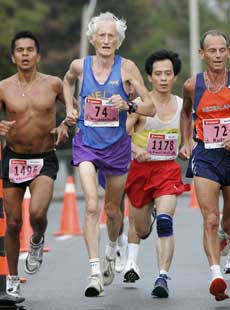
Elite Duathlete Jennifer Faraone is hosting two trail running clinics at Rattlesnake Point, Milton Ontario.
June 2 Trail Running for Beginners
Elite Duathlete Jennifer Faraone is hosting two trail running clinics at Rattlesnake Point, Milton Ontario.
June 2 Trail Running for Beginners
This brief post has two main points:
and
Further, nothing in this post is even remotely new.
Dr McGill is teaching a two day course on his research behind spine stability. I have been an admirer of Stu for more than 17 years and was lucky enough to do more MSc under his supervision.
I consistently learn a great deal from Dr McGill and encourage anyone with even a passing interest in spine stabilty and athletic performance to see him speak or read his work
Course information at The msk-plus website.
In part one of this post I very simple reviewed some of the ideas behind core stability and how I questioned their relevance to a patient’s pain presentation. In this follow up post I will briefly review how people with pain have different function than those without pain and give an opinion on how core ‘stability” exercises may help with patients in pain in a manner that has nothing to do with stabilizing the spine.
Purpose: To cherry pick a few research articles to suggest that even though our knowledge of core stability is very impressive its link to pain is poor.
Nutshell summary: People in pain have spines that function differently than those not in pain. Many treatments can influence pain. The spine stability model of low back pain does not explain how people have pain and takes an overly mechanical view of the pain experience. No test has ever shown that a spine is unstable or how “increasing stability” would lead to a decrease in pain. Thinking that our spines need more stability or control may be the completely wrong path in explaining how people have pain or how our exercises help them. Our treatment “corrections” occur not via one specific “corrective” mechanism (e.g. improving stability) but rather through global non-specific mechanisms that our better explained by our understanding of pain neuroscience. Making the shift from believing that “stability” is the issue with pain can thus free up to choose completely different exercise programs. Exercise and treatment prescription thus become simpler. We have preliminary evidence to support this view with the clinical studies that show benefits with the various exercise conditioning programs that train different schools of thought on stability or the just as effective programs that completely ignore any concepts of stability.
Audience: Patients
Purpose: I recommend a lot of hip exercises and consider variety and novelty important for people in pain and for athletic injury rehabilitation. This is just a catalog of pictures. Please don’t do them and don’t consider these to be the be and end all for exercises. Many other exercises can also be chosen to achieve your goals. Below is a catalog of a number of exercises that you can use to train/stress your hips. (more…)
Audience: Patients and other health care providers
Purpose: To explain my treatment approach to Persistent Pain Problems.
A recent article in BMJ by Deb Cohen entitled “The truth about sports drinks” got a lot of people very excited, me included. The article seemed well written to me but I don’t know enough in this area to be legitimately critical. And that was the problem with the article. Most of us know relatively nothing about an area but read a seemingly good article in a well respected big medical journal and its easy to take everything at face value when perhaps it shouldn’t be. Fortunately others know better about sport drinks and have started to write rebuttals. Of course, these rebuttals or counterpoints should have been included alongside the original piece – that lets us be the informed consumer of science. There are two sides to everything in this grey, gray, not black, not white world of body science. Below is the original article and some responses from the involved and often maligned parties.
Deb Cohens initial piece ” The truth about Sports Drinks”
Dr. Stu Phillips from McMaster University initial response here
Dr. Michael Sawka interesting response here
Audience: Therapists and Strength Coaches
Purpose: To justify the use of a variety of exercises (even general exercises) for training, rehabilitation and injury prevention and question the application of movement specificity principles.
The Gist of this Post: Specificity of training is an important component of rehabilitation and strength and conditioning but I think the application of specificity can be taken too far when we attempt to mold our posture. (more…)